Top Climate and ESG books in 2025!
There’s no two ways about it – 2025 has been a turbulent twelve months for the climate and sustainability movements.
During the inevitable moments when my confidence has wobbled, I have found it useful to stop doom scrolling, put down my laptop and pick up a book. And what a joy it is to live in a time when there are so many amazing books covering every aspect of these complex topics, written by brilliant authors from all around the world.
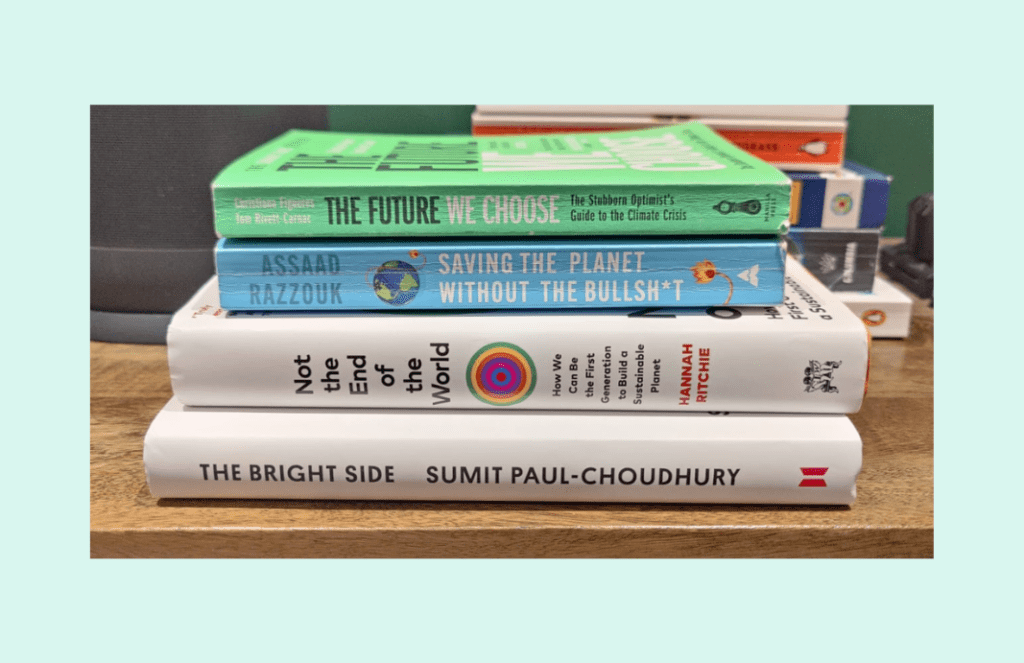
Books that don’t just remind me what’s at stake, but that highlight how far we have already come and how we can keep moving forward. Books that share a lifetime of hard-earned wisdom and then translate those lessons into practical insights that I can take into my daily work as a climate and ESG lawyer. Books that remind me of my responsibility to future generations. Books that renew my resolve, when I can feel my courage waning.
In no particular order, here are five of the books that have kept me positive and moving forward during a challenging 2025, and a brief extract from each. I hope you enjoy it.
Tickling Sharks, by John Elkington
If you are passionate about sustainability and committed to working (and leading!) in this space, Tickling Sharks, by John Elkington, is a real treat. I have been lucky enough to meet John in person and quickly fell for his easy going and funny but also deeply authoritative and thoughtful style. These traits ooze through Tickling Sharks, which is a real joy of a book.
Tickling Sharks tells the story of the sustainability movement, how it evolved from its very earliest days, and how those leading the charge found ways to get businesses to engage with the sustainability agenda. It is a story of impact, innovation, perseverance and creativity.
There are very few people out there who genuinely qualify as a ‘legend’ in the sustainability space. John does. This book is a wonderful insight into his journey and some of the lessons he learned on the way.
Top tip – if you are keen to read this book but your proverbial reading list is full, get a copy and skip right to the ‘Coda’ at the back, which you can work through in half an hour. In the Coda, John shares ten excellent lessons that all of us can apply to better engage with key decision-makers as part of our daily work in the sustainability space. The Coda is so insightful I made a point of reading it twice!
“Sustainability is now going exponential because it must…Such mainstreaming can and will spook people stuck in older, and increasingly threatened realities.”
Not the end of the world – Hannah Ritchie
In my late 20s I would lie awake in bed panicking on almost a nightly basis. I was in the midst of a full blown case of climate anxiety. There were so many different problems swirling around in my head, none of which seemed solvable. Individually they were bad enough. But taken collectively? I couldn’t help but feeling like we were unavoidably doomed.
Not the End of the World by Hannah Ritchie is the book I wish I had found at the peak of my climate anxiety. It offers a rigorous, data led explanation of where we are now, where we need to be and how we can get there, looking at not just climate change but also air pollution, deforestation, food, biodiversity loss, ocean plastics and overfishing.
In a clear, practical and optimistic way, Hannah highlights the amazing progress that has already been made and charts a sensible path forward across each of these challenges, including practical steps that we can take individually, and welcome reminders of things we should “stress less about” in our daily efforts to live more sustainable lives.
I was fortunate to see Hannah speaking at an event earlier this year. Her calm, realistic but upbeat persuasion was a strong reminder of why I got so much from this excellent book. Her new book – Clearing the Air, is firmly on my reading list for 2026.
“That’s the challenge we face. We need to make sure that every one in the world can live a good life and we need to reduce our environmental impacts so that future generations can flourish too. That puts us in uncharted territory. No previous generation had the knowledge, technology, political systems, or international cooperation to do both at the same time. We have the opportunity to be the first generation that achieves sustainability. Let’s take it.”
Higher Ground, by Alison Taylor
“In a feverish atmosphere where polarization and misinformation flourish, there is no reliable way to avoid criticism, please all stakeholders, and manage reputational risk.” Unfortunate, and invariably true. But – if you are looking for a thoughtful framework to help navigate this very complex challenge that all businesses are facing, Higher Ground is a great place to start.
Higher Ground thoughtfully engages with the realities of running a business in the digital age. It focuses carefully on how businesses can use human rights as a solid foundation for their corporate strategy and reflects thoughtfully on how businesses might pursue a balance between profit and purpose.
One of the debates that I particularly enjoyed focused on which topics a business should and should not engage with as part of their public comments, recognising that silence is not an option in many instances on the one hand, and that any comments from businesses on most topics will inevitably be met with a degree of scepticism on the other. How businesses walk that tightrope is not a topic I had previously spent much time considering, but it is important as part of a holistic approach to corporate ESG.
Higher Ground offers a genuinely fresh perspective on this complex and evolving space, supported by a wide range of case studies that are used to highlight different challenges throughout the book. If you work with or advise businesses struggling with these challenges, Higher Ground is well worth a read.
“If you manage a business, one of the most profound consequences of mass internet access is that you can no longer control your narrative… Today, the public crowdsources opinions on where to work and what to buy, then sceptically compares them to the corporate narrative in question.”
Saving the Planet without the Bullsh*t – Assaad Razzouk
One of the (many!) things I really like about Assaad is his fearless ability to call something out for exactly what it is.
Saving the Planet without the Bullsh*t is a powerful call for systemic change, driven by law, policy, finance and regulation. It skilfully takes the heat and focus off individuals and puts the onus (quite properly) onto the governments, policy makers and big businesses who could actually achieve real change, if they were so inclined.
This excellent book is a “manifesto of how to live in the midst of a climate catastrophe and how to effect real change”, reminding us not to be guilted into inconsequential behaviours in the name of the planet so that big businesses can continue with business as usual, rather than addressing the harms many of them are causing.
It is, at times, a tough read. But it is also an important reminder to direct our individual energy and efforts where we can genuinely have the most impact. And that is about changing government attitudes and corporate behaviours, not depriving ourselves of an occasional flight or stressing about whether we are over-using the air conditioning by a degree or two to keep our homes cool on a hot day.
I strongly recommend that you go and enjoy this book. And if you are hungry for more, Assaad has an excellent podcast: The Angry Clean Energy Guy, which you can check on the usual streaming platforms.
“While informed individual efforts to be eco-friendly are important in galvanizing others, this book argues that they largely miss the mark… We are in critical need of major systemic changes: 89 per cent of emissions come from burning oil, gas and goal, and just stopping subsidies for fossil fuels would cut global emissions by a third. Yet cash subsidies for fossil fuel consumption alone amounted to $440 billion globally in 2021… How do we make these systemic changes happen? And what is the most effective role for individuals as we switch to clean energy to fuel global lifestyles?”
The Future We Choose – Christiana Figueres and Tom Rivett-Carnac
Christiana Figueres and Tom Rivett-Carnac are two of the hosts of my favourite podcast: Outrage + Optimism. They are also, together, largely responsible for steering the world towards the success of the Paris Agreement in 2015. It is the learnings from that journey which, in part, make The Future we Choose such a compelling book.
One of the ideas from this book that I have incorporated into my daily life is what Christiana and Tom refer to as ‘Stubborn Optimism’, a powerful – positive mindset, that you can learn to adopt with practice – even in the face of something as daunting as the climate crisis.
Beyond focusing on the importance of adopting the right mindset, this excellent book offers the authors’ views on ten key steps that each of us can take to choose a more positive future, from letting go of the old world to seeing ourselves as citizens and not consumers, engaging in politics and using technology responsibly.
The Future We Choose was the first book I read in 2025. If you are looking for something inspiring to kick off your 2026, I highly recommend it to you.
“Optimism is not soft, it is gritty. Every day brings dark news, and no end of people tell us that the world is going to hell. To take the low road is to succumb. To take the high road is to remain constant in the face of uncertainty. That we may be confronted by barriers galore should not surprise anyone. That we may see worsening climate conditions in the short term should also not surprise us. We have to elect to boldly persevere. With determination and utmost courage, we must conquer the hurdles in order to push forward.”
Bonus tip: If you fancy a deep dive into the power of optimism, I also enjoyed reading The Bright Side – Why Optimists Have the Power to Change the World by Sumit Paul-Choudhury, which is well worth a spot on your reading list!
….
I was luck enough to have lunch with Assaad Razzouk in March 2025. Before we parted ways, I pulled out my copy of Saving the Planet without the Bullsh*t and asked Assaad if he would sign it for me.
He paused, thought for a moment, and then wrote:
Dear Josh
“Inveniam viam aut faciam”
With all my best
Assaad
“Inveniam viam aut faciam” is a Latin phrase famously attributed to Hannibal. It means “I shall either find a way or make one”.
…
Whether you are a lawyer like me, a sustainability consultant, an activist, a politician, a student or even a young person trying to find your place in this world, trying to make a useful contribution to the global efforts against climate change can sometimes feel like an intensely lonely endeavour.
But the truth is, none of us is doing this alone, nor do we have to start from scratch. There are thousands of brilliant people out there who have been working this problem for years, many of whom have been generous enough to share their insights in excellent books that are waiting to guide us through the difficult moments ahead.
For my part, I try and take a grounded, data driven approach like Hannah Ritchie. I try to be a stubborn optimist, channelling my inner Christiana Figueres and Tom Rivett-Carnac. I challenge myself to tickle the corporate sharks I encounter with the deft wisdom of John Elkington, gently guiding them towards the Higher Ground advocated for by Alison Taylor. And when I need to – from time to time – I calmly but confidently call out those who would cling to the old world and their bullsh*t, exactly as Assaad would have us all do.
Whether you are finding a way or making one, you don’t need to do it alone. By embracing the wisdom and knowledge of these excellent authors and their wonderful books, each of us can expand our toolkits as advocates for a more planet-positive future.
And if, like me, you feel your resolve slipping from time to time, I hope these books will help steady your proverbial ship – as each of them has done for me over the course of this year.
And let’s strap in folks. Because in 2026… we are going to do it all again.
…
This article is a follow up to my top ten books on climate change, published in 2024. You can find that list here: Top ten books to get educated about climate change! | Gen-R Law
Get in touch
We opened our doors on 4 March 2024. As a relatively new firm, we are not yet in a position to offer all of the services described on this website. We have done our best to make clear what we can do now, and what forms part of our exciting plans for the years ahead. We are working hard to make our ambitious vision into a reality.
In the meantime, please do subscribe to receive our regular thought leadership and feel free to follow our journey and progress on LinkedIn.